If you’re operating in a crowded market, publishing random blog posts will not move rankings in a meaningful way. Competitive niches demand depth, structure, and strategic focus. Topical authority is not about how much you publish. It is about how completely and consistently you cover a subject.
Search engines now evaluate semantic relevance, content relationships, and expertise signals. What this really means is simple: if your site demonstrates complete understanding of a topic across multiple layers, it earns trust. And trust translates into sustained rankings.
Let’s break down how to build topical authority the right way in competitive niches.
What Topical Authority Actually Means
Topical authority is your domain’s demonstrated expertise across an entire subject area, not just a single keyword. Instead of ranking because you optimized one page well, you rank because your website covers interconnected subtopics with clarity and depth.
This is supported by:
- Strong content hierarchy
- Logical internal linking strategy
- Clear search intent alignment
- Consistent publishing within defined topic clusters
- Visible E-E-A-T signals
In saturated industries like digital marketing, SaaS, finance, or health, this layered coverage is what separates page one domains from everyone else.
Why Single Articles Don’t Work in Competitive Niches
In less competitive spaces, a well-written article can rank on its own. In aggressive markets, that rarely happens. You are competing against websites that have dozens or hundreds of interconnected resources around the same subject.
If you run a seo services company, publishing one page targeting SEO services is not enough. You need supporting content covering areas like technical audits, keyword research
frameworks, on-page optimization, link acquisition, industry-specific SEO, algorithm updates, and performance tracking.
Search engines interpret this structure as expertise. When multiple related pages reinforce each other through contextual links, you build semantic relevance and stronger entity association.
Authority is built across clusters, not isolated URLs.
Define a Clear Topical Boundary
One of the biggest mistakes in competitive niches is trying to rank for everything. Authority requires focus.
Start by defining your core expertise:
- What problems do you solve?
- What services drive your business?
- Who is your ideal audience?
If you position yourself as a seo agency, your ecosystem should revolve around search growth, organic visibility, and ranking strategy. Publishing unrelated content without structure dilutes authority and confuses search engines about your specialization.
The narrower your focus, the stronger your authority becomes within that space.
Build a Strategic Topic Ecosystem
Once your boundary is defined, map your entire topic universe. This is where many websites fall short. They chase high-volume keywords but ignore the full semantic landscape.
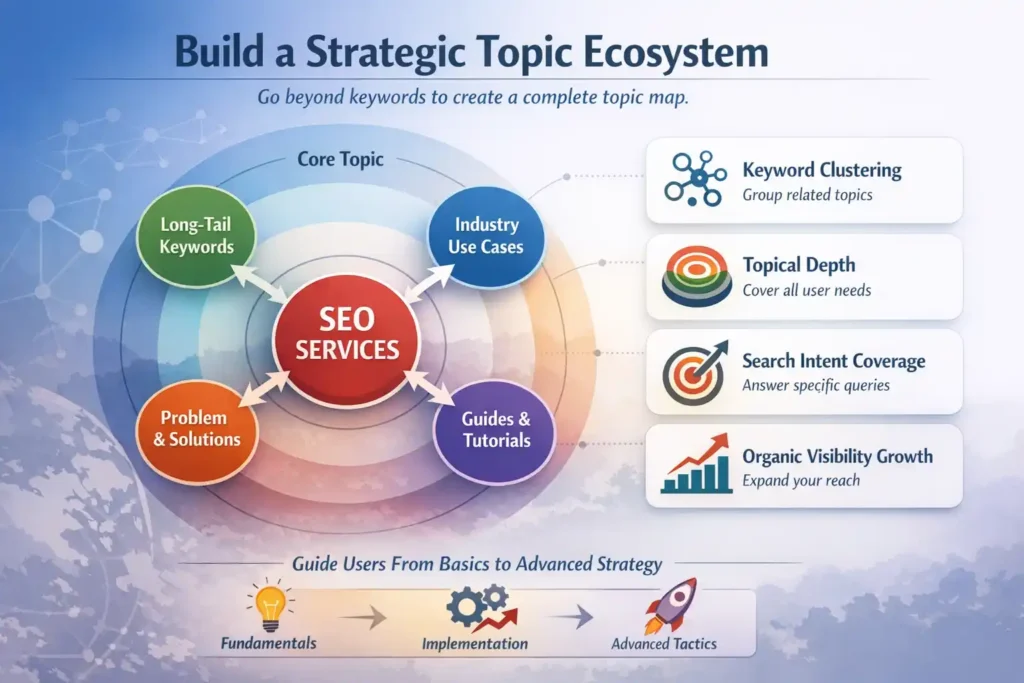
For example, if your primary service is seo services, expand into related layers such as long-tail queries, industry use cases, problem-based searches, and implementation guides.
This supports:
- Keyword clustering
- Topical depth
- Search intent coverage
- Organic visibility growth
Instead of writing similar posts targeting slight keyword variations, build distinct, purposeful pages that answer specific user questions thoroughly.
The goal is to mirror how users explore a topic from basic understanding to advanced strategy.
Create Strong Pillar Pages
A pillar page acts as the foundation of your topic cluster. In competitive niches, this page must be comprehensive and strategic, not surface-level.
A strong pillar page explains the process, methodology, challenges, tools, and measurable outcomes. If you provide seo services, your main page should break down how audits are conducted, how strategies are built, how technical issues are resolved, and how results are measured.
Search engines reward completeness. A pillar page should serve as a central hub that naturally links to deeper subtopic articles.
When properly structured, this improves crawlability, strengthens indexation signals, and distributes link equity across your cluster.
Go Deep with Focused Subtopics
After establishing your pillar, create focused content that dives deep into narrower areas. This is where topical authority truly compounds.
Instead of repeating broad advice, develop advanced resources. Write about technical SEO audits in detail. Break down search intent mapping frameworks. Explain how link building works in enterprise industries. Cover niche-specific challenges.
This level of detail improves:
- Content relevance
- Topical expansion
- User engagement signals
- Search performance stability
Search engines begin to see your site not as a participant, but as a contributor to the knowledge base around that topic.
Structure Internal Linking with Purpose
Internal linking is not just navigation. It is a signal system that tells search engines how your content is related.
In competitive niches, this structure matters.
Your subtopic pages should link back to the main pillar page. Related articles should reference each other naturally. Anchor text should describe the topic clearly instead of using vague phrases.
This strengthens crawl efficiency, reinforces content hierarchy, and improves user journey flow.
For a seo agency, this means your blog on technical optimization should logically connect to your primary SEO services page and other relevant resources.
When structure aligns with topic depth, authority grows.
Demonstrate Real Expertise
Topical authority is not only about structure. It is also about proof.
Search engines evaluate signals tied to expertise and experience. That includes case studies, data-backed examples, author credibility, and original insights.
If you offer seo services, demonstrate how rankings improved, how traffic increased, and how technical issues were resolved. Explain the reasoning behind your strategy rather than offering generic advice.
Adding real-world implementation detail strengthens E-E-A-T signals and differentiates your content from competitors repeating the same surface-level information.
Experience builds trust. Trust builds rankings.
Cover Advanced and Overlooked Angles
Most websites in competitive niches stop at basics. That is why much of the content feels identical.
To build authority faster, explore angles that are often ignored. Discuss algorithm impact analysis. Share lessons from failed campaigns. Explain technical trade-offs. Break down industry-specific search behavior patterns.
This expands your topical depth while strengthening content differentiation.
Authority increases when your site becomes the place users go for answers they cannot find elsewhere.
Optimize for Entities, Not Just Keywords
Modern search engines interpret topics through entities and relationships. Your goal is to become strongly associated with your core topic.
You can strengthen entity signals by maintaining consistent terminology, using structured data, building relevant backlinks, and ensuring your content ecosystem reinforces the same thematic focus.
When your domain consistently publishes high-quality resources around search strategy and optimization frameworks, search engines associate your brand with that topic space.
Over time, a seo services company that consistently reinforces its thematic focus becomes contextually strong within the search ecosystem.
Maintain and Expand Over Time
Topical authority is cumulative. It compounds with consistency.
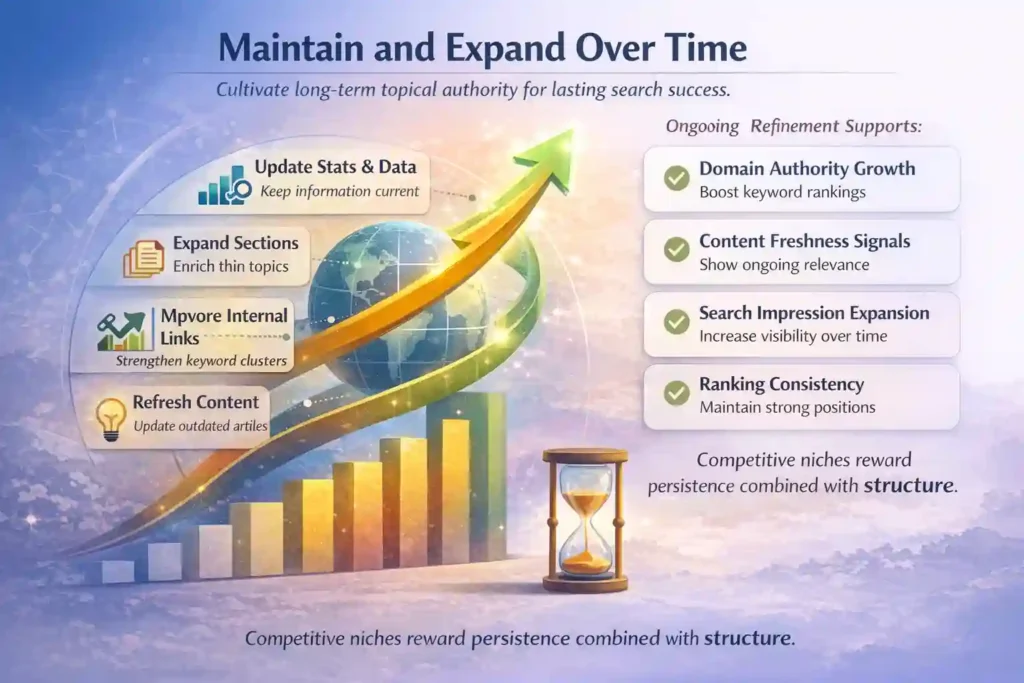
Instead of publishing aggressively and stopping, build a long-term strategy. Refresh outdated content. Expand thin sections. Update statistics. Improve internal linking as clusters grow.
This ongoing refinement supports:
- Domain authority growth
- Content freshness signals
- Search impression expansion
- Ranking consistency
Competitive niches reward persistence combined with structure.
Measure Topical Strength, Not Just Single Rankings
Many businesses obsess over a handful of keywords. That approach misses the bigger picture.
A better metric is total keyword coverage within a cluster. If your SEO topic ecosystem begins ranking for hundreds of related terms, your topical authority is strengthening.
Look at search impressions, organic traffic trends, click-through rate improvements, and topic-based performance growth.
When your cluster as a whole expands in visibility, that is the real indicator of authority.
Building topical authority in competitive niches is not about chasing algorithms. It is about owning a subject through structure, depth, expertise, and consistency. When your content ecosystem reflects genuine mastery and strategic organization, search engines recognize that clarity.
That is how brands offering seo services move from competing for rankings to dominating their topic space.
FAQ’s
Topical authority is not immediate. In competitive industries, it typically takes several months of consistent publishing, structured internal linking, and content expansion before search engines begin recognizing depth. The timeline depends on your domain strength, content quality, and how strategically your topic clusters are built.
There is no fixed number. Authority is based on coverage, not volume. A well-structured cluster of 15–30 deeply connected, high-quality pages around one focused subject can outperform 100 scattered blog posts. What matters is completeness and logical interconnection.
Domain authority reflects overall backlink strength and trust across a website. Topical authority reflects expertise within a specific subject area. A smaller site can outrank a larger competitor if it demonstrates deeper, more structured coverage of a single topic.
Yes. Internal linking helps search engines understand relationships between pages. When subtopics consistently link back to a central pillar page and to related resources, it reinforces content hierarchy and strengthens semantic relevance within the cluster.
Backlinks accelerate authority, but structured topical coverage can build strong relevance signals even before significant external links are acquired. However, in highly competitive niches, combining deep content clusters with quality backlinks produces stronger and more stable rankings.