Search engines no longer rank pages based only on matching keywords. They interpret meaning, context, and relationships between concepts. That shift has reshaped SEO from a keyword game into a structured, entity-driven discipline.
If you want long-term visibility, especially in AI-powered search environments, you need to understand how entity-based SEO works and how to implement it with precision.
Let’s break it down.
What Is an Entity in Modern Search?
An entity is a clearly defined thing. It can be a person, place, organization, product, event, or concept. What makes it powerful is that it exists independently of the words used to describe it.
For example, a search engine understands that “Apple” could refer to a fruit or a technology company. It distinguishes meaning based on context, relationships, and user intent.
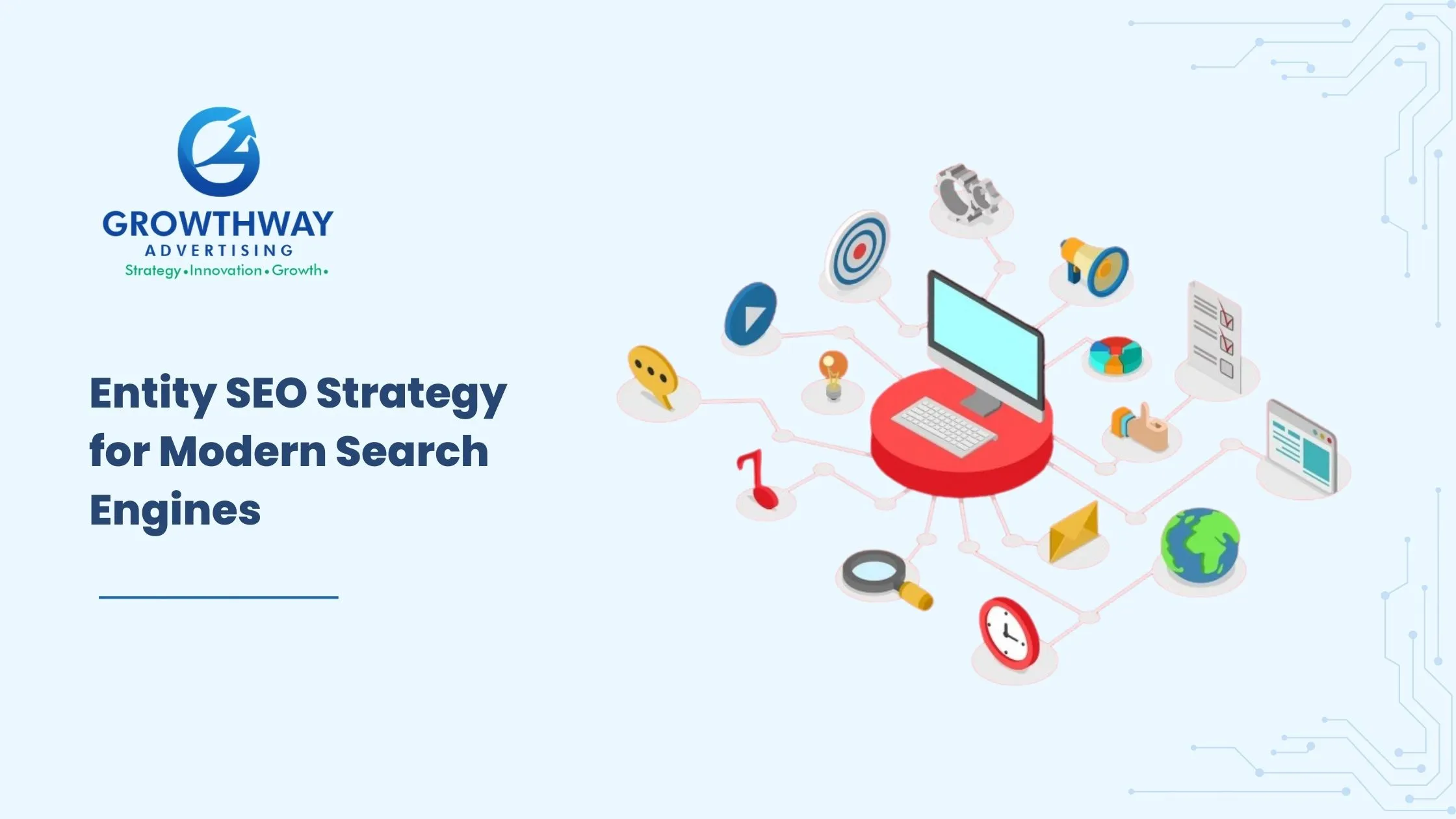
Modern algorithms build massive knowledge graphs that map entities and their connections. Instead of just seeing strings of text, search engines see structured relationships.
That’s the foundation of entity-based SEO.
How Search Engines Understand Entities vs Keywords
Traditional SEO focused on keyword frequency and placement. Today, search engines use natural language processing, vector embeddings, and entity recognition to interpret content more intelligently.
Here’s the core difference. Keywords are strings of text. Entities are things with attributes and relationships.
When someone searches for “best CRM for real estate,” search engines do not simply match words. They identify entities like software platforms, industries, features, pricing models, and user reviews. Then they analyze how those entities connect and which sources demonstrate authority within that network.
This is where semantic search optimization becomes critical. Instead of targeting isolated phrases, you build content around topics, subtopics, and relationships.
Modern algorithms evaluate contextual relevance, topical depth, entity co-occurrence, authority around subject clusters, and structured signals through markup.
What this really means is that surface-level keyword targeting is no longer enough.
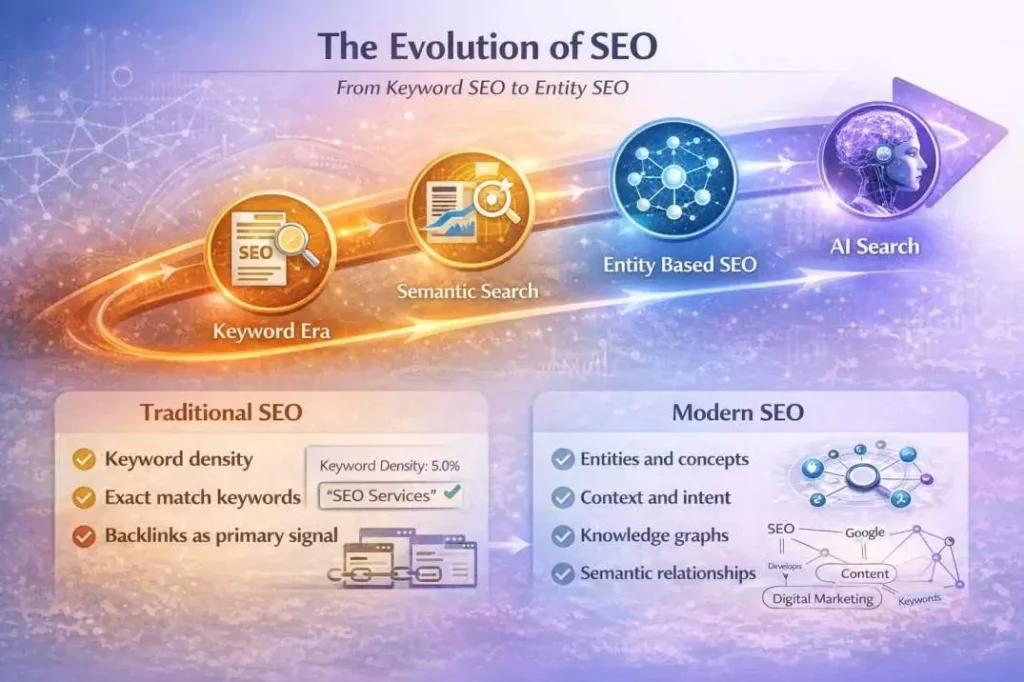
The Role of Knowledge Graphs in Search Visibility
Google and other search engines maintain knowledge graphs to connect entities across the web. These graphs store attributes, relationships, and contextual signals.
When your business is clearly defined as an entity within this system, you gain enhanced visibility in rich results, stronger contextual ranking signals, improved brand recognition in AI summaries, and greater trust through entity validation.
That’s where knowledge graph optimization enters the picture.
Optimizing for knowledge graphs involves aligning your brand, content, and structured data so search engines confidently understand who you are, what you do, and how you relate to other entities in your industry. It is not about adding markup randomly. It is about reinforcing identity and relationships consistently across your digital footprint.
Structured Data and Schema Markup: The Technical Foundation
If entities are the strategy, structured data is the infrastructure.
Schema markup allows you to label your content in a way search engines can interpret accurately. Instead of guessing what a block of text represents, crawlers can read explicit signals such as organization details, services offered, authorship, FAQs, and case studies.
When implemented correctly, structured data supports entity-based SEO by clarifying business identity, connecting authors to content, linking products to brands, and associating services with industries.
It also improves eligibility for rich results, featured snippets, and AI-generated summaries.
But here is the important nuance. Schema alone does not build authority. It confirms and strengthens the authority already demonstrated through content depth and consistency. Without a well-structured content ecosystem, markup becomes cosmetic rather than strategic.
Entity Relationships and Topical Authority
Search engines evaluate not just individual entities but how they connect within a broader topic map.
If your business provides digital marketing solutions, your authority should extend naturally across related entities such as search engine marketing, content strategy, technical optimization, analytics platforms, and conversion rate optimization. When these relationships are clearly structured across your site, algorithms begin to associate your domain with that thematic cluster.
This is where content clustering becomes strategic rather than tactical.
Instead of publishing isolated blog posts, build a central pillar page that defines your primary entity and then create in-depth supporting content that expands into related sub-entities. Internal links should reinforce these relationships logically, not randomly.
Over time, search engines recognize your domain as authoritative within that cluster. This is how you move from ranking for keywords to owning a topic.
A structured approach like this is typically implemented by a professional seo services company that focuses on durable authority rather than short-term traffic spikes.
AI-Driven Search and Context Modeling
Search is evolving quickly due to large language models and AI-generated responses.
AI-powered systems analyze query context, historical behavior patterns, semantic similarity, entity relationships, and intent classification. Instead of presenting a simple list of links, they generate synthesized answers built from multiple sources.
If your content lacks entity clarity or contextual completeness, it becomes less likely to be included in these generated summaries.
That is why semantic search optimization is no longer optional.
To compete in AI-driven environments, your strategy must clearly define primary entities, establish strong associations, maintain consistent brand signals, and support everything with structured data. When done correctly, your brand becomes part of the semantic network AI models rely on to produce answers.
Practical Steps to Implement an Entity SEO Strategy
Theory is useful. Execution is what moves rankings.
First, define your core entity. Clarify who you are, what services you provide, which industries you serve, and what differentiates you. This information must remain consistent across your website, social profiles, directory listings, and industry mentions. Consistency strengthens entity validation.
Next, map related entities. If you provide seo services, your related entities might include technical audits, link acquisition strategies, on-page optimization, local search, analytics tools, and content marketing frameworks. Create comprehensive content that explains how these elements connect to your primary offering.
Then implement structured data strategically. Add schema for organization details, services, authors, and FAQs where appropriate. Avoid over-marking pages. The goal is clarity, not excess.
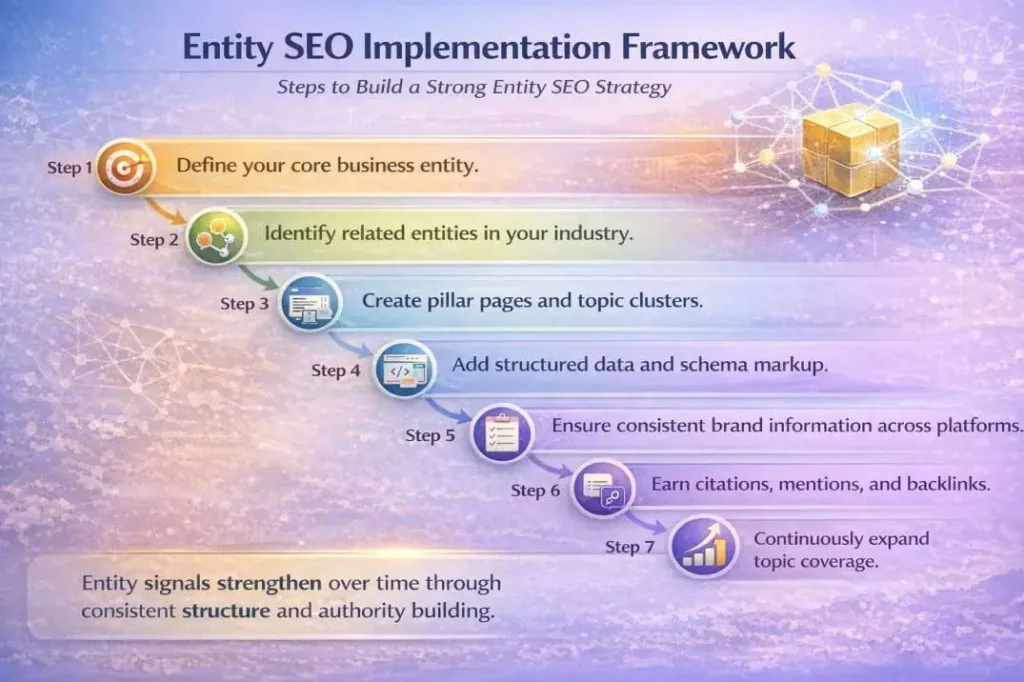
After that, build authority through clusters. Develop in-depth pillar pages supported by well-researched articles that expand into related concepts. Every internal link should reinforce a logical relationship between entities.
Finally, strengthen external entity signals. Search engines validate businesses across the broader web. Industry mentions, consistent NAP data, author bios, brand citations, and guest contributions all help confirm your entity identity. An experienced seo agency aligns on-site optimization with these off-site reinforcements to create a unified presence.
Common Mistakes Businesses Make
Many companies adopt the language of entity SEO but fail in execution.
One common mistake is over-focusing on keywords without contextual depth. Repetition does not create authority. Structured relationships do.
Another issue is ignoring structured data entirely. Without markup, search engines must infer meaning, which reduces clarity and certainty.
Inconsistent brand signals also cause problems. Variations in business name, address, or service descriptions fragment your entity identity and weaken recognition.
Thin cluster content is another risk. Publishing shallow articles around related topics without real substance dilutes authority instead of strengthening it.
Perhaps the biggest mistake is treating entity optimization as a one-time task. Entity signals compound over time. Authority grows through continuous expansion, refinement, and consistency.
Why Strategic Support Matters
Entity SEO involves technical implementation, semantic modeling, content architecture, and digital PR coordination. It requires long-term planning and cross-functional alignment.
This is where professional seo services create leverage.
A structured seo agency approach includes entity audits, semantic gap analysis, schema framework implementation, content clustering strategy, and ongoing monitoring of knowledge graph presence. Without this discipline, businesses often end up with fragmented signals and unstable visibility.
How Entity SEO Impacts Long-Term Growth
When your business becomes a recognized entity within a defined topical ecosystem, search visibility becomes more stable. Rankings fluctuate less because they are supported by contextual authority rather than isolated keyword wins.
You also gain stronger performance in AI-generated answers, improved brand recognition, higher trust signals, and greater resilience to algorithm updates.
Instead of reacting to every ranking change, you align your strategy with how modern search fundamentally interprets information.
That alignment is the real power of entity-based SEO.
FAQ’s
It is an SEO strategy that focuses on optimizing identifiable concepts like brands, products, and topics rather than just keywords.
Traditional SEO emphasizes keyword placement. Entity SEO prioritizes meaning, relationships, and structured context.
No. It improves clarity and eligibility for enhanced results, but strong content and authority remain essential.
It strengthens how search engines recognize and connect your brand with relevant topics and industries.
Yes. Clear entity signals allow smaller brands to compete through topical authority instead of relying only on backlinks.
Yes. AI systems rely heavily on entity relationships and contextual clarity.