Search behavior has fundamentally changed. A growing share of Google searches end without a single click to any website. For businesses investing in SEO services and digital visibility, this represents a serious challenge but also a misunderstood opportunity. Understanding what Zero Click Searches are, why they happen, and how to engineer your content strategy around them is now a non-negotiable part of modern SEO strategy.
This blog breaks down the full picture: the mechanics, the data, what most content on this topic glosses over, and most importantly, exactly how brands can still capture meaningful traffic and authority even when Google answers the question before users ever visit a site.
What Are Zero Click Searches, Really?
Zero Click Searches occur when a user’s query is resolved directly on the search engine results page (SERP) without them needing to click through to any external website. Google displays the answer, through a featured snippet, a knowledge panel, a local pack, a calculator, a currency converter, or increasingly through AI overviews and the user’s intent is satisfied right there.
This isn’t an edge case anymore. Studies from SparkToro and SimilarWeb suggest that over 50% of all Google searches in some markets now result in zero clicks. On mobile, that figure climbs even higher. This is the new baseline of organic search, and any SEO agency worth its retainer should be building client strategies that account for this reality.
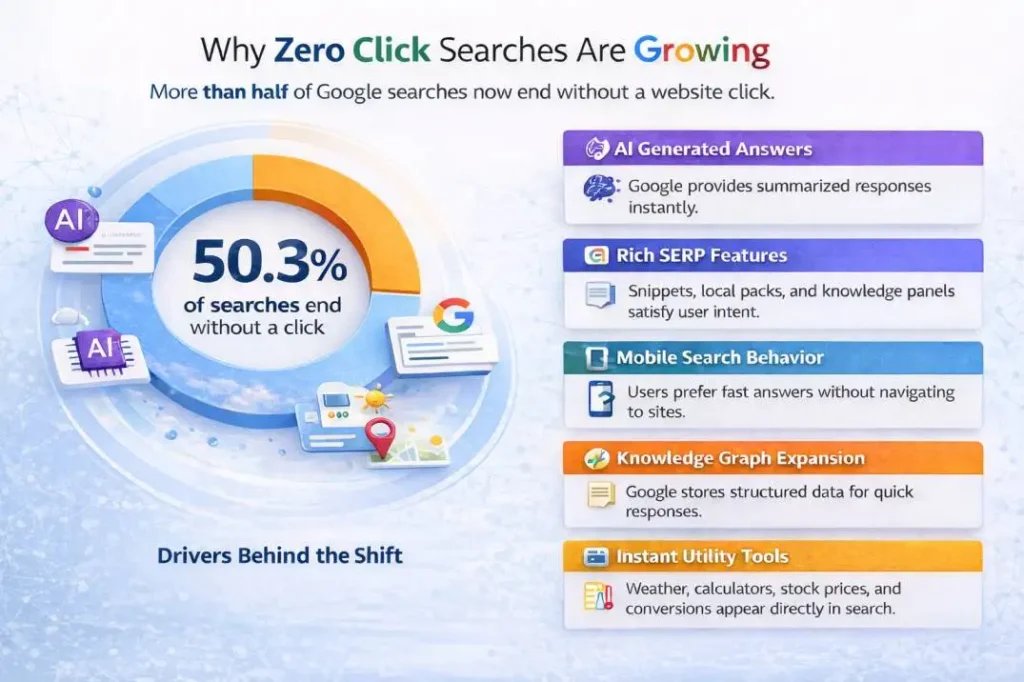
The types of queries most likely to generate zero-click results include:
- Direct factual questions (e.g., “what is the capital of France”)
- Unit conversions and calculations
- Weather lookups and sports scores
- Stock prices and currency exchange rates
- Simple definitions and knowledge panel queries
- Branded entity searches resolved by Google’s knowledge graph
These are high-volume, low-friction queries where Google has trained itself to be the final destination.
The Rise of AI Overviews and What It Means for Organic Traffic
The introduction of AI overviews, Google’s generative AI summaries that appear at the top of SERPs has supercharged the zero-click phenomenon. Unlike traditional featured snippets, which pull a specific passage from one source, AI overviews synthesize information from multiple sources and present a composite answer. This makes the SERP itself even more self-sufficient.
For informational queries especially, AI overviews are now intercepting traffic that previously flowed to top-ranking pages. A blog post that once captured 3,000 organic visits per month for “how to fix a leaky faucet” may now get far fewer clicks, even if it still ranks on page one. The visibility remains, but the click-through rate (CTR) shrinks.
What most content on this subject fails to address is the nuance here: AI overviews don’t kill all traffic, they redirect it. Queries with commercial, comparison, and deep research intent still drive clicks because a synthesized paragraph cannot replace the depth, trust, and specificity users need to make purchasing decisions or solve complex problems. This is where a smart SEO strategy focuses its energy.
The Hidden Opportunity Most SEO Guides Miss
Here’s what the conversation about Zero Click Searches typically overlooks: being the source that Google quotes in a featured snippet or AI overview is still valuable, arguably more valuable than a quiet ranking in position five with no snippet.
When your content appears in a featured snippet, you receive brand exposure at scale. Thousands of users see your domain name, your framing of the answer, and your tone even if they don’t click. This contributes to:
- Brand recall and top-of-mind awareness in your niche
- Downstream direct search behavior, users searching your name later
- Increased trust signals that improve performance across other channels
- Competitive protection, if you don’t own the snippet, a competitor will
Proactive snippet optimization is defensive as much as it is offensive. Losing the snippet position to a competitor is a visibility loss with no upside.
How to Optimize for Featured Snippets and AI Overviews
Structure Your Content for Direct Answers
Google’s snippet algorithm rewards content that answers questions directly, immediately, and in a format that is easy to extract. Best practices include:
- Lead with the answer, state it clearly in the first 40–60 words under a relevant heading
- Mirror question phrasing in H2 and H3 tags (e.g., “What is entity-based SEO?”)
- Use clean, well-structured ordered and unordered lists where appropriate
- Keep paragraph answers to 2–3 sentences for definition-style queries
- Use tables for comparison data, Google often pulls these into featured results
Use Schema Markup and Structured Data
Implementing schema markup particularly FAQ schema, HowTo schema, and Article schema gives Google explicit signals about the nature and structure of your content. This improves the probability of your page being selected as a snippet source and being referenced in AI overviews. An experienced SEO agency will prioritize schema implementation as a core technical deliverable, not an afterthought.
Target the Right Query Intent
Not all queries are worth pursuing for snippet optimization. Focus on:
- Comparison queries — “X vs Y” (carries transactional signals)
- Process queries — “how to choose X” or “how to fix X”
- Evaluative queries — “best X for Y” or “is X worth it”
- Definition queries — high snippet capture rate, good for brand exposure
Purely informational queries with zero purchase intent are lower priority, even capturing the snippet may yield minimal business value.
Building a Zero-Click-Resilient SEO Strategy
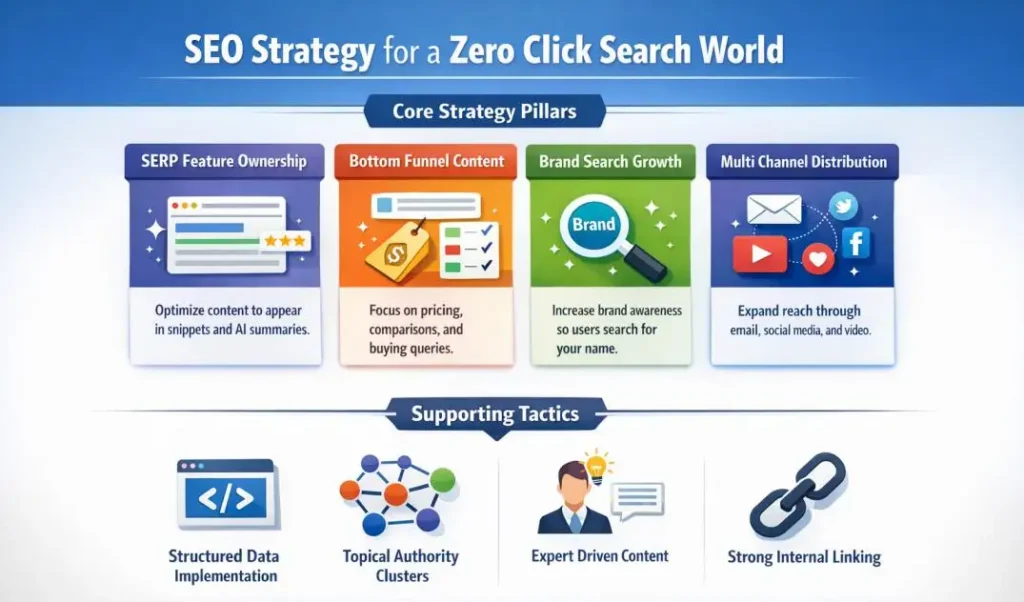
The brands that will win in a zero-click world are those that stop measuring success purely by organic clicks and start measuring it by total search presence. Here’s what that means in practice for your SEO strategy:
Prioritize bottom-of-funnel content. Queries like “[product] pricing”, “[service] near me”, “[brand] reviews”, and “[product] alternatives” are far less vulnerable to zero-click displacement. Users asking these questions need depth, nuance, and real-world information that a SERP snippet simply cannot provide. This is where clicks still live.
Invest in branded search volume. One of the most durable outcomes of strong SEO services is growing branded search demand. When users who’ve encountered your content in featured snippets or social channels return and search your name directly, that traffic is zero-click-proof.
Build topical authority, not just keyword rankings. Google’s systems increasingly favor sites that demonstrate comprehensive expertise on a subject. A site that covers a topic from every angle, answers every adjacent question, and earns links from credible sources is the kind of site that gets cited in AI overviews. Thin, scattered content strategies don’t qualify.
Diversify your traffic sources. Brands that pair strong SEO strategy with email list growth, YouTube content, podcast presence, and social media distribution are insulated against SERP volatility. Your content can be discovered through search and then followed through other channels where you own the relationship.
A practical resilience checklist for your content program:
- At least 40% of content targets commercial or transactional intent
- All key pages include FAQ schema and relevant structured data
- A brand awareness strategy runs in parallel to organic SEO
- Google Business Profile is fully optimized for local visibility
- Topical clusters cover subjects end-to-end, not just isolated keywords
Local SEO and Zero Click: A Special Case
Local queries deserve separate attention. When users search for “coffee shops near me” or “emergency plumber [city]”, the Google local pack often resolves the query without a click to any website. The business is found, the phone number is dialed, or directions are opened, all within the SERP.
For local businesses, winning the zero-click moment means optimizing:
- Google Business Profile categories, services, and attributes
- Business hours, location data, and NAP consistency across directories
- Photo quantity and quality, listings with photos earn more profile actions
- Q&A responses — pre-answering common questions directly in GBP
- Review volume and recency — a key local ranking and trust signal
A knowledgeable SEO agency will treat Google Business Profile as a primary asset in local SEO services, not a secondary checklist item.
The Zero-Click Angles Most Brands Overlook
Most SEO strategy conversations around Zero Click Searches focus only on chasing snippets harder. But there are deeper shifts worth understanding:
The click-quality shift. Yes, clicks are declining for informational queries. But clicks that do happen are increasingly from users with higher intent. If zero-click results filter out casual browsers and deliver only motivated users, your conversion rates on remaining organic traffic may actually improve. Traffic volume and traffic value are different metrics.
The impression economy. Impressions on Google Search even zero-click impressions feed brand familiarity, which has measurable effects on paid ad performance, direct traffic, and email open rates. A brand that appears in AI overviews and featured snippets constantly is building a kind of ambient authority that influences all other channels.
The content depth gap. AI overviews are built from surface-level information. They struggle to synthesize:
- Original research and proprietary data
- First-hand case studies and real client outcomes
- Expert opinion and nuanced professional judgment
- Highly specific, niche knowledge that exists nowhere else online
Content that goes beyond what can be scraped and summarized is naturally more resistant to zero-click displacement. If your content sounds like what an AI might generate, an AI will generate it and leave you out.
Measuring Success in a Zero-Click World
If you’re working with SEO services providers or evaluating your internal team, the metrics need to evolve beyond raw organic sessions. Track these instead:
- Impressions by query type — are you gaining SERP presence even without clicks?
- Average CTR by keyword category — informational vs commercial vs branded
- Branded vs non-branded traffic split over time
- Share of voice across target keyword clusters
- Google Business Profile actions: calls, direction requests, website clicks
- Conversion rates by traffic source — quality matters more than volume
Search Console’s performance data lets you track average CTR by query. If impressions are rising but clicks are flat, you’re winning visibility in a zero-click environment, which may be the best possible outcome for many informational keywords. The goal is to appear, be trusted, and be remembered.
Any SEO agency building a strategy that doesn’t account for SERP feature ownership, AI overview presence, schema optimization, and non-click brand touchpoints is working from an outdated playbook. Zero Click Searches have changed the game and the teams that adapt their SEO strategy accordingly are the ones that will own the next chapter of organic search.
FAQ’s
Zero click searches are increasing because search engines now aim to provide immediate answers on the results page. Features like AI overviews, featured snippets, and knowledge panels allow users to get quick information without leaving Google.
They can reduce clicks for simple informational queries. However, websites that provide deeper insights, comparisons, or solutions still receive traffic because users often need more detailed information than what appears on the search results page.
Queries that typically produce zero click results include quick factual questions, definitions, weather searches, sports scores, currency conversions, and basic calculations.
Content should answer questions clearly, use structured headings, include concise explanations, and apply schema markup. Lists, tables, and direct definitions also increase the chances of appearing in snippets.
Yes. Zero click searches are more common on mobile devices because users prefer quick answers. Mobile search results often highlight features like local packs, knowledge panels, and AI summaries.
Instead of focusing only on traffic, businesses should also track impressions, SERP feature visibility, branded searches, Google Business Profile actions, and conversion rates from organic visitors.