Search engines reward relevance, depth, and scale. For service businesses, achieving that combination through traditional content strategies alone can be difficult. Creating individual pages manually for every service variation, location, or niche takes time and resources.
This is where Programmatic SEO changes the equation.
Instead of building every page one by one, programmatic strategies allow businesses to generate hundreds or even thousands of highly targeted pages using structured data, templates, and automation. When executed correctly, it helps service providers capture long-tail search traffic and answer very specific user queries.
For companies offering seo services or operating as an seo agency, programmatic methods can dramatically expand visibility across multiple service areas, industries, and customer needs.
Let’s break down how this strategy works and how service-based businesses can implement it effectively.
What Programmatic SEO Really Means
Programmatic SEO is a scalable search optimization strategy where large numbers of pages are created using structured templates combined with data sets. Instead of writing every page manually, businesses build a framework that automatically generates optimized pages based on specific variables.
For example, a digital marketing company could create pages like:
- SEO services for restaurants
- SEO services for dentists
- SEO services for real estate agencies
- SEO services in Pune
- SEO services in Mumbai
Each page targets a different search query while following a structured format.
This approach allows businesses to capture searches that traditional content strategies often miss.
Another important part of Programmatic SEO is ensuring each generated page still delivers meaningful information. Search engines prioritize pages that provide real value rather than thin or repetitive content.
That means the goal is not just to create more pages but to create useful pages at scale.
Why Programmatic SEO Works Well for Service Businesses
Service-based businesses naturally have multiple combinations of offerings, industries, and locations. Each of these combinations represents a search opportunity.
For example, people search things like:
- digital marketing services for startups
- SEO agency for ecommerce
- PPC management for small businesses
- website development services in Pune
These searches represent high intent users looking for specific solutions.
By implementing Programmatic SEO, service providers can create targeted landing pages that match these queries.
Some key benefits include:
1. Massive Long-Tail Keyword Coverage
Most search traffic comes from long-tail queries. These are detailed searches that traditional SEO content often overlooks.
Using Programmatic SEO, businesses can build pages targeting variations such as:
- service + industry
- service + location
- service + problem
- service + business size
This allows an seo agency to capture thousands of keyword opportunities that competitors may ignore.
2. Faster Content Production
Creating hundreds of pages manually is unrealistic for most teams. Programmatic frameworks allow pages to be generated automatically once templates and data structures are ready.
This significantly reduces the time required to expand search visibility.
3. Better Alignment With Search Intent
Users searching for highly specific solutions want answers tailored to their situation.
Pages created through Programmatic SEO can address queries like:
- SEO services for law firms
- SEO services for healthcare businesses
- SEO services for local contractors
When content speaks directly to a user’s context, engagement and conversion rates improve.
Common Programmatic SEO Page Types for Service Businesses
Service companies can implement several types of scalable pages.
Location-Based Pages
Many service searches include geographic intent.
Examples include:
- SEO services in Pune
- SEO agency in Bangalore
- digital marketing services in Mumbai
Creating location-focused pages helps businesses appear in regional searches.
Industry-Specific Service Pages
Different industries require different marketing approaches.
For example:
- SEO services for ecommerce stores
- SEO services for real estate agencies
- SEO services for medical clinics
By building industry-focused pages, businesses demonstrate expertise while targeting highly relevant queries.
Problem-Solution Pages
Users frequently search for solutions to specific problems.
Examples include:
- how to improve website rankings
- why my website is not ranking on Google
- how to get more leads from SEO
Service providers can create pages addressing these challenges and present their solutions.
Building the Data Structure Behind Programmatic SEO
The foundation of Programmatic SEO lies in structured data.
Instead of writing separate pages manually, businesses create a database containing variables that generate unique content combinations.
Typical variables may include:
- service type
- industry
- location
- business size
- customer problems
For instance:
Service: SEO
Industry: Healthcare
Location: Pune
This structure can automatically generate a page targeting “SEO services for healthcare businesses in Pune.”
This structured approach ensures consistency while enabling massive scalability.
Creating High-Quality Templates
One of the biggest mistakes businesses make with Programmatic SEO is using thin templates.
Search engines now evaluate page quality more deeply. That means templates must provide useful, unique insights for each variation.
A strong template typically includes:
- Introduction tailored to the query
- Explanation of the service
- Industry or location specific insights
- Process or methodology
- Benefits for that audience
- FAQs addressing search questions
For example, an seo agency targeting healthcare businesses should mention compliance considerations, patient search behavior, and medical content standards.
This contextual information prevents pages from feeling repetitive.
Internal Linking Strategy for Programmatic Pages
Large sets of pages require strong internal linking structures.
Without proper linking, search engines may struggle to discover and index programmatic content.
Some effective strategies include:
- Linking location pages to service pages
- Creating pillar pages for core services
- Connecting industry pages with related solutions
For example:
A page about seo services could link to subpages such as:
- SEO services for ecommerce
- SEO services for healthcare
- SEO services for SaaS companies
Internal links help search engines understand relationships between topics while distributing authority across pages.
Content Personalization Within Programmatic Pages
Even though pages are generated using templates, they must still feel personalized.
This can be done by inserting dynamic elements like:
- industry statistics
- local market insights
- relevant examples
- tailored FAQs
For instance, a page targeting restaurants may discuss local search visibility, menu keyword optimization, and review management.
Meanwhile, a page targeting SaaS companies may highlight product-led growth strategies and technical SEO.
These differences make programmatic pages genuinely useful rather than formulaic.
Handling Duplicate Content Risks
Search engines penalize duplicate or low-value content. Poorly implemented Programmatic SEO can easily fall into this trap.
To avoid issues:
- Add unique data points for each page
- Include custom FAQs related to the target audience
- Modify sections of the template dynamically
- Integrate industry or location specific insights
For example, a page targeting seo services in Pune should include information about the regional market, competition, and local business trends.
Similarly, an industry page should address unique challenges faced by that sector.
These adjustments ensure each page offers distinctive value.
Automation Tools Used in Programmatic SEO
Implementing Programmatic SEO often involves a mix of tools and systems.
Common components include:
- Content management systems
- spreadsheet databases
- automation workflows
- API integrations
These tools allow businesses to connect structured data with page templates.
An seo agency may also use automation to update large sets of pages when services or offerings change.
For example, updating pricing, service features, or case studies across hundreds of pages can be done quickly with centralized data sources.
Measuring the Success of Programmatic SEO
Once pages are live, tracking performance becomes essential.
Businesses should monitor:
- organic traffic growth
- impressions for long-tail keywords
- conversion rates from programmatic pages
- indexed pages in search engines
Many companies discover that programmatic pages attract highly qualified visitors because they match precise search intent.
For example, someone searching “SEO services for law firms in Pune” already knows what they want. A well-optimized page targeting that query has a strong chance of converting.
When Programmatic SEO Should Not Be Used
Despite its advantages, Programmatic SEO is not suitable for every situation.
It works best when:
- there are many keyword variations
- the business serves multiple industries or locations
- structured data can generate meaningful page differences
However, if every page ends up looking identical or offering minimal value, the strategy can backfire.
Quality and relevance always matter more than scale.
The Future of Programmatic SEO for Service Businesses
Search engines are becoming smarter. They now evaluate context, authority, and user satisfaction more deeply.
This means successful Programmatic SEO strategies will focus less on page volume and more on intelligent content generation.
Service companies that combine structured automation with valuable insights will dominate long-tail search opportunities.
For businesses offering seo services or operating as an seo agency, this approach creates a powerful advantage. Instead of competing for a small set of keywords, they can capture thousands of search queries that reflect real customer needs.
As search behavior continues evolving, scalable SEO frameworks will become an essential part of modern digital marketing strategies.
FAQ’s
Programmatic SEO is a method of creating many targeted web pages at scale using templates and structured data so businesses can rank for large numbers of specific search queries.
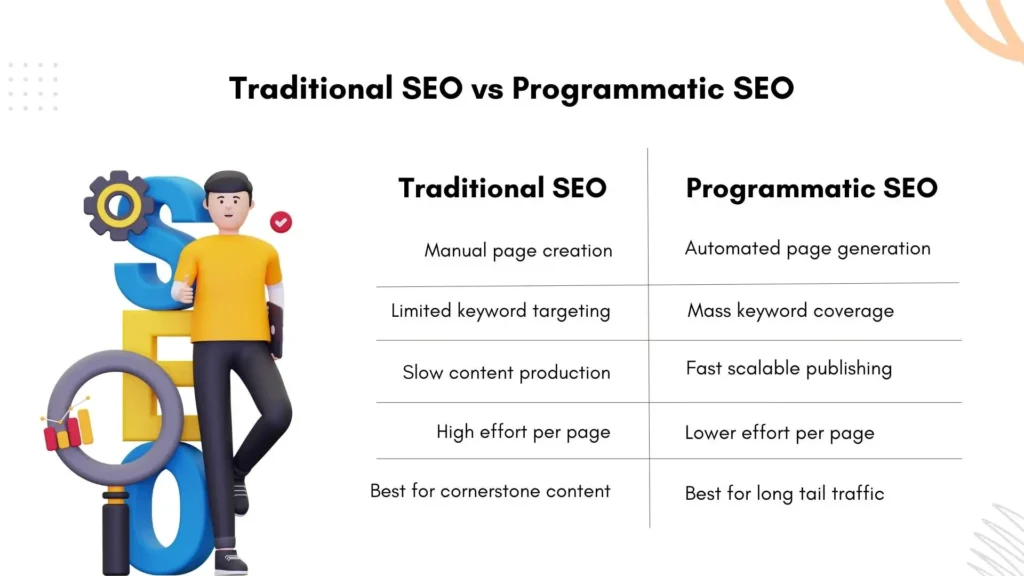
Traditional SEO focuses on manually creating and optimizing individual pages. Programmatic SEO uses automation and data sets to generate hundreds or thousands of relevant pages efficiently.
Service businesses usually serve multiple locations, industries, and customer needs. Programmatic SEO helps them create dedicated pages for each variation and capture high intent searches.
Common page types include location pages, industry specific service pages, problem solution pages, and service comparison pages.
Long tail keywords with clear intent work best, such as service plus location, service plus industry, and service plus customer problem queries.
Initial indexing can happen quickly, but meaningful traffic growth usually takes a few months depending on competition, content quality, and domain authority.