Your customers are not living in one channel. They are Googling, scrolling social media, opening emails, and clicking ads, sometimes all in one afternoon. If your marketing channels are not talking to each other, you are leaving money on the table and frustrating the very people you are trying to win over.
An omnichannel strategy ties all of these touchpoints together so your brand feels consistent, your message lands at the right moment, and your marketing budget goes further. It is not about being everywhere. It is about being everywhere in a coordinated, intelligent way.
This guide walks you through how to build an omnichannel strategy that works in 2026, using SEO services, PPC services, and marketing automation services as your three core engines.
What Omnichannel Really Means
Multichannel vs. Omnichannel: The Key Difference
Multichannel marketing means you are present on multiple platforms: email, social, search, and paid ads. Each channel operates independently, often with separate strategies and separate data. You show up in a lot of places, but you are delivering a different experience on each one.
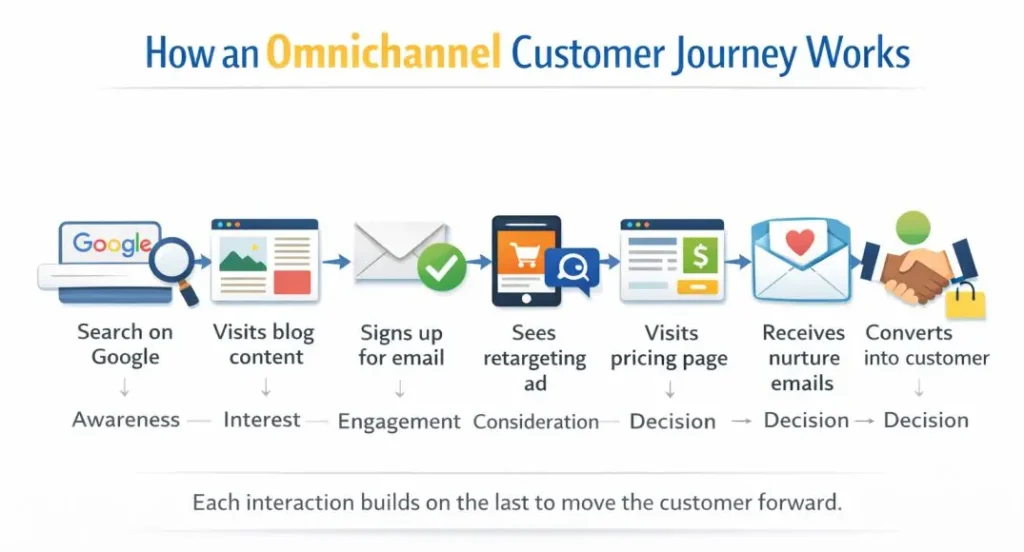
Omnichannel marketing means every channel is connected. The customer who reads your blog post today sees a relevant retargeting ad tomorrow and receives a personalized email the following week. Every interaction informs the next, so the experience feels continuous rather than fragmented.
The core difference:
Multichannel is about presence. Omnichannel is about continuity. One puts you on more channels; the other makes those channels work as one unified system.
Why Being Everywhere Without a System Hurts You
Adding more channels without a unifying system does not multiply your results. It divides your attention and dilutes your message. Without a connected strategy, a prospect might read your blog and then see an ad for a completely unrelated offer. Your email team and paid media team might run conflicting promotions at the same time. And because no single system is tracking the full journey, you have no idea which channel actually drove the conversion.
The result is higher spend, lower conversion, and a customer experience that feels disjointed. A focused strategy on two well-connected channels will consistently outperform an uncoordinated presence across six.
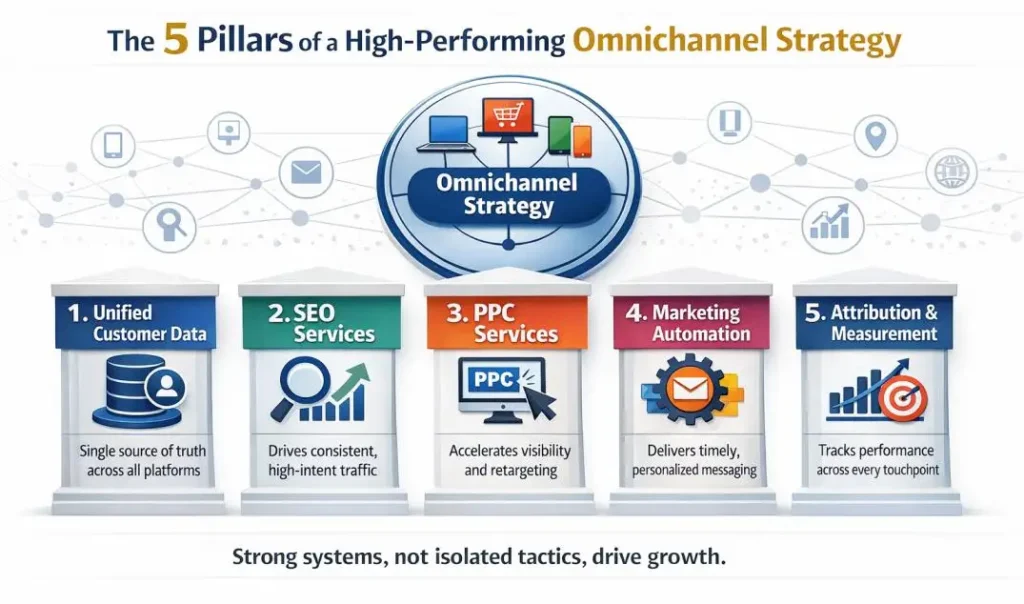
The Five Pillars of an Omnichannel Strategy in 2026
1. Unified Customer Data
Every omnichannel strategy lives or dies on data. If your tools are not sharing information, your channels cannot coordinate. A data silo occurs when customer information is trapped inside a single platform. Your ad platform knows who clicked your ads, your email tool knows who opened your newsletters, and your CRM knows who became a customer, but none of them communicate with each other.
A Customer Data Platform (CDP) solves this by aggregating data from every touchpoint into a single unified profile. In 2026, the most effective omnichannel stacks use a CDP to unify data, a CRM to manage the sales layer, and a marketing automation platform to trigger the right messages at the right time, all working from the same source of truth.
With third-party cookies largely phased out, first-party data is now the foundation of effective targeting. Build systems to collect data directly from your audience through email sign-ups, gated content, surveys, and preference centres. The businesses winning in omnichannel today are those who invested early in first-party data infrastructure.
2. SEO as Your Always-On Foundation
Paid media needs a budget to run. Email needs someone on your list. Social media needs an algorithm to cooperate. SEO services, by contrast, create an asset that works around the clock, attracting qualified prospects at the exact moment they are searching for what you offer.
Professional SEO services do more than improve rankings. The keyword research that underpins a strong SEO strategy tells you what your customers are actually searching for, and that insight becomes the foundation for your ad copy, email subject lines, and landing page messaging. A high-ranking blog post also creates remarketing audiences for paid campaigns and improves your Quality Score in paid search.
For businesses with a physical presence, local SEO services add another critical omnichannel layer. Optimising your Google Business Profile, building local citations, and creating location-specific content ensures your digital presence converts to real-world enquiries and foot traffic.
3. Paid Media as Your Accelerator
If SEO builds long-term momentum, PPC services provide the acceleration. Paid media lets you show up instantly for high-intent searches, re-engage people who have already visited your site, and put a highly specific message in front of a precisely defined audience at a precisely chosen moment.
The most effective paid strategies in 2026 are built on top of organic foundations, not instead of them. A good PPC management service will target keywords where you are close to ranking organically, amplify your best-performing content with paid promotion, and retarget the audiences your organic content has already attracted.
Effective cross-channel retargeting is segmented and sequential. Someone who reads a blog post sees an ad offering related content. Someone who visits a pricing page sees social proof and a direct offer. Someone who abandoned a checkout sees a timely reminder. Each message matches where the prospect is in their journey, and frequency caps ensure the experience feels helpful rather than intrusive.
4. Marketing Automation as the Glue
Marketing automation services are what make omnichannel possible at scale. Without automation, coordinating personalized, timely messages for thousands of prospects across multiple channels is not realistic. With it, the entire system runs on logic and triggers rather than manual effort.
A well-configured automation platform acts as the central nervous system of your omnichannel strategy. When a prospect downloads a content piece from organic search, automation captures the lead and begins a relevant nurture sequence. When they visit a specific product page, automation triggers a targeted follow-up email or flags them for a sales call.
The most powerful automation responds to real behaviour rather than a fixed schedule:
- Visited the pricing page but did not convert: trigger a case study email 24 hours later
- Opened three emails in a row but never clicked: trigger a re-engagement offer
- Downloaded a guide on Topic A: trigger a sequence covering Topic B, the logical next step
- No engagement in 60 days: trigger a win-back campaign with your highest-value content
5. Measurement and Attribution Across Channels
Last-click attribution assigns all conversion credit to the final touchpoint, typically a branded search or direct visit. In an omnichannel model, this approach is misleading. It ignores the blog post that first introduced the prospect to your brand, the retargeting ad that brought them back, and the email sequence that moved them to take action.
Multi-touch attribution distributes credit across every touchpoint in the journey. For most businesses in 2026, a data-driven or position-based model gives the clearest picture of what is actually driving growth. Your reporting dashboard should connect data from your SEO tools, ad platforms, email platform, and CRM into a single view, so you can see where prospects come from, what path they take, and where they drop off.
How to Build Your Omnichannel Strategy Step by Step
Step 1: Map your customer journey first
Before opening a single ad platform or automation tool, map out how your ideal customer moves from first awareness to purchase. What triggers them to start looking? Which channels do they use at each stage? What questions do they ask, and what objections do they need to overcome? Your omnichannel strategy should be built around this journey, not around what channels happen to be popular right now.
Step 2: Choose your core channels, not all of them
For most B2B businesses, the right starting point is organic search, paid search, email, and LinkedIn. For most B2C businesses, it is organic search, paid social, email, and remarketing. Master these channels and integrate them properly before adding more. A smaller, well-connected set of channels will always outperform a larger, disconnected one.
Step 3: Integrate your tools and data
Your CRM, email platform, analytics, ad accounts, and website need to share data. Set up conversion tracking across all channels, connect your ad platforms to your CRM, and establish consistent UTM parameters and naming conventions so you can trace every touchpoint back to revenue.
Step 4: Test one channel pair before scaling
Start with one channel pair, such as SEO and email. Build the workflow: organic traffic arrives, a prospect downloads content, an automation sequence begins, and engaged prospects are flagged for sales. Once that is working well, layer in paid retargeting, then expand. Incremental integration with measurement at each step is how you build a system that scales reliably.
What Great Omnichannel Looks Like in Practice
Here is what a complete omnichannel journey looks like from first touch to conversion.
A prospect named Sarah is researching solutions to a problem your product solves. Your SEO services have earned you a page-one ranking for a high-intent search query. She finds your long-form guide, reads it thoroughly, and subscribes to your newsletter before leaving.
Sarah does not convert immediately, which is entirely normal. Your PPC management service has set up a retargeting audience of visitors who engaged with that specific guide. Two days later, Sarah sees a social media ad featuring a relevant case study. She clicks through, reads it, and visits your pricing page.
Her visit to the pricing page triggers a behaviour-based automation sequence from your marketing automation services. Over the next five days, Sarah receives three emails: a breakdown of how similar businesses use your product, a short video walkthrough, and an invitation to book a discovery call. She books the call and becomes a customer.
Because your attribution model is set up correctly, you can see the full path: organic search introduced her, paid social re-engaged her, and automated email converted her. You know exactly which content, which ad, and which email made the difference, so you can scale what worked.
The result:
A seamless experience for the prospect. Clear, actionable data for your team. And a repeatable acquisition process that runs systematically rather than by luck.
Ready to Connect Your Channels?
We help businesses connect SEO, paid media, and automation into one seamless strategy.
If you are tired of your channels working in silos and ready to build something that compounds, let us talk. We will audit your current setup, identify the gaps, and build a clear roadmap that ties everything together.
Whether you are starting from scratch or looking to strengthen an existing strategy, our team brings deep expertise across SEO services, PPC management, and marketing automation services. You get a partner who can see and build the full picture. Contact us today
Your customers are already moving across channels. It is time your marketing moved with them.
FAQ’s
An omnichannel marketing strategy connects all your marketing channels so they work together as one system. Instead of running separate campaigns, every interaction a customer has with your brand is coordinated and builds on the previous one.
Multichannel means you are active on multiple platforms, but they operate independently. Omnichannel connects those platforms so messaging, data, and customer experience remain consistent across every touchpoint.
Customers now switch between search, social, email, and ads constantly. Without a connected strategy, you lose context and conversions. Omnichannel ensures you stay relevant at every stage of the customer journey.
The key components include unified customer data, SEO services, PPC services, marketing automation services, and a clear attribution model to track performance across channels.
Start by mapping your customer journey, choosing a few core channels, integrating your tools, and testing one connected workflow before scaling to more channels.